
Building the future with sustainable infrastructure and innovative design


Professor

Assistant Professor

Assistant Professor

Assistant Professor

Assistant Professor
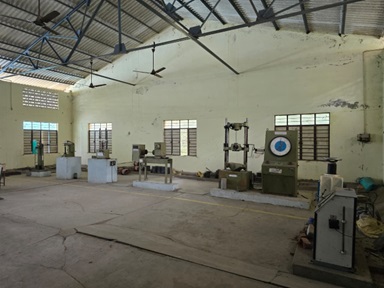
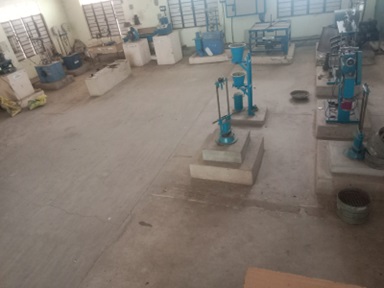
The Material Testing Laboratory is designed to provide practical knowledge on the properties and behavior of construction materials. It enables students to determine the mechanical properties of steel through standard testing methods. The laboratory facilitates the evaluation of physical properties of cement, including consistency and setting time. Students conduct tests on fine and coarse aggregates to assess grading and strength characteristics. The workability of concrete is studied using standard tests. Compressive strength of concrete is determined to understand its load-carrying capacity. The strength characteristics of bricks are evaluated through compression tests. Wood testing is carried out to study its strength properties. These experiments help students understand material quality and performance. Overall, the laboratory trains students to follow standard testing procedures used in civil engineering practice.
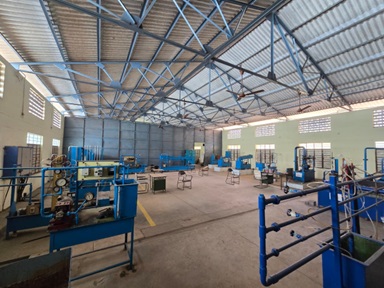
This lab is run in conjunction with the theory course applied hydraulics engineering. It is an introductory course where flow behavior, fluid forces and analysis tools are introduced. The goals of the experiments include determination of forces generated when fluid flow takes place over a solid object, applications of the control volume approach, demonstration of the momentum and energy equations, viscosity measurement and engineering correlations. Experimental setups such as flow through a tube, flow over a flat plate, orifice-meter, roto-meter, determination of friction factor through pipes and viscometer are made available to the students. The lab experiments utilize U-tube manometer and digital manometer to measure the pressure difference between the systems. The lab runs closely with the lectures in such a way that experiments support the text covered in the class room. The element of the turbine machine is common for all turbine machines and is called an impeller, also turbine wheel, rotor, screw or runner. Additionally, students are learning about turbine machines like pumps, fans, compressors, water turbines, gas turbines, steam turbines, wind turbines, etc.
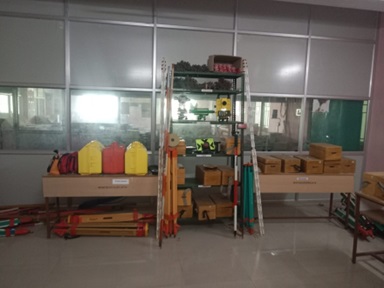
The Surveying and Levelling Laboratory provides practical training in modern surveying instruments and techniques used to measure distances, elevations, and angles. Through hands-on fieldwork, students gain a clear understanding of surveying methods essential for accurate planning and mapping. The laboratory enhances technical skills required for site layout, alignment, and execution of civil engineering projects. This practical exposure prepares students for professional roles in surveying, construction, and infrastructure development.
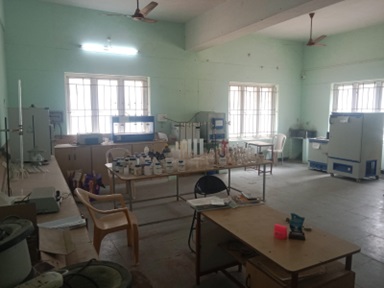
The Water and Wastewater Analysis Laboratory provides practical training in the analysis and characterization of water and municipal wastewater. Students learn standard procedures for assessing quality parameters, calibrating and standardizing equipment, and collecting and preserving samples. The laboratory emphasizes both field-oriented and laboratory testing methods, including coliform analysis to evaluate microbial contamination. This hands-on experience enhances students’ understanding of environmental quality standards and prepares them for professional roles in water and wastewater management.
The Soil Mechanics Laboratory develops students’ skills in testing soils for their index and engineering properties and in characterizing soils based on standard methods. Students conduct experiments to determine index properties, in-situ density, and compaction characteristics. The laboratory also provides hands-on experience in evaluating the compressibility, permeability, and shear strength of soils. In addition, students gain exposure to various tests on geosynthetics, enhancing their understanding of geotechnical engineering applications and soil behavior in civil engineering projects. The Highway Engineering Laboratory provides practical knowledge on the principles and procedures for testing materials used in highway construction. Students learn to characterize pavement aggregates through standard laboratory tests. The laboratory enables evaluation of the quality and strength of aggregates used in road works. Testing of bitumen is carried out to assess its quality and suitability. Students evaluate the consistency and engineering properties of bitumen. The Marshall Method is used to determine the optimum binder content. Practical sessions help in understanding bituminous mix design. Students learn to determine the bitumen content in bituminous mixes. The laboratory emphasizes adherence to highway specifications and standards. Overall, it prepares students for professional practice in highway and pavement engineering.
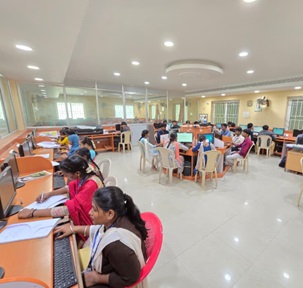
The Building Drawing and Detailing Laboratory imparts knowledge and skills in building drawing using computer-aided design software. Students learn to draft plans, elevations, and sectional views of load-bearing and framed structures. The laboratory provides training in structural detailing of RCC elements. Students gain experience in detailing RCC water tanks, footings, and retaining walls. Steel structure detailing is also covered in the laboratory. Emphasis is given to industrial structure detailing. Practical sessions help students understand construction drawings and standards. The lab enhances drafting accuracy and presentation skills. It bridges theoretical knowledge with practical design applications. Overall, the laboratory prepares students for professional roles in design and drafting.
Download the complete syllabus including course structure and learning outcomes.
Download SyllabusDownload the complete syllabus including course structure and learning outcomes.
Download Syllabusa. Quiz
b. Z-A Approach
c. Flipped Class room
d. Jig Saw/ Reciprocal teaching
e. Think Pair Share
f. Interactive Lecture & Lab Demonstration
g. Student seminar
h. Mind mapping
i. Industrial visit
j. Team based Learning
k. Suitable Analogies.
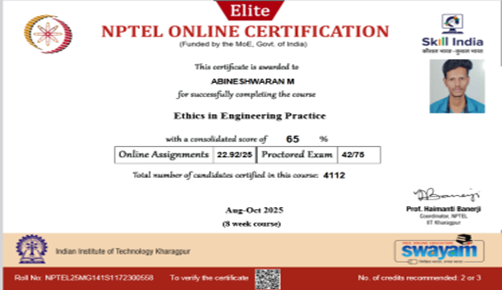
OUR FINAL YEAR STUDENT ABINESHWARAN M (922022103001) HAS ATTENDED AND GOT ELITE CERTIFICATION IN THE COURSE OF “ETHICS IN ENGINEERING PRACTICES” IN NPTEL.
OUR FINAL YEAR STUDENT ABINESHWARAN M (922022103001) HAS ATTENDED AND GOT ELITE CERTIFICATION IN THE COURSE OF “ETHICS IN ENGINEERING PRACTICES” IN NPTEL.
Faculty achievements will be updated soon.

Role of BIM in construction: Hands on training with REVIT
Role of BIM in construction: Hands on training with REVIT
Value added course information will be updated soon.
No MoU details available

Life Member - IEI

Life Member - ISTE
Student Chapter - ACI
Life Member - IGS
Life Member - IEI
Life Member - ISTE
Student Chapter - ACI
Life Member - IGS